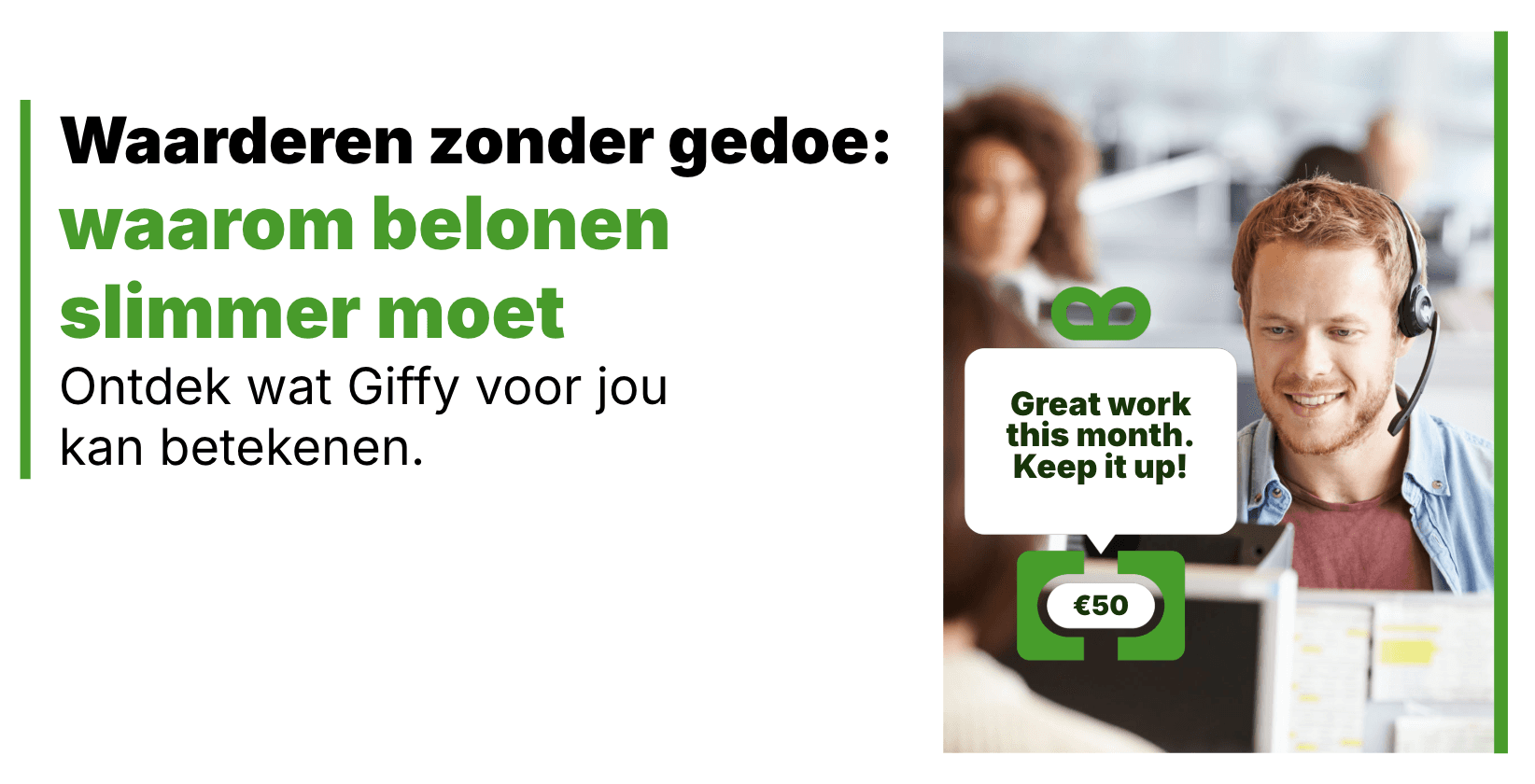
Appreciating without hassle: why rewarding needs to be smarter
Pascal van Dalen
By
· Last updated:
Ordering procedures feel like a bureaucratic obstacle course, invoices get lost, and gifts disappear unused in drawers. This has to change.
According to Pascal van Dalen, CEO of Giffy, many organisations genuinely want to thank their employees but get bogged down in the execution. "It needs to be simpler, faster, and above all, more effective," he says. "HR teams already have enough on their plate. Rewards should be a means to motivate employees, not an additional administrative burden."
The water bottle with a logo is dead. Long live freedom of choice!
The Christmas hamper with snacks. The Dopper with a logo. The company mug. They are all symbols of well-intentioned but poorly thought-out appreciation. "A gift only really works when someone receives something that makes them happy," says Van Dalen. “And that is exactly the challenge: generic gifts do not suit a diverse workforce with different tastes and preferences.”
Many companies continue to stick to traditional gifts, but the reality is that these often do not meet the needs of employees. A reward that matches the recipient's personal preferences has a much greater impact.
Increasingly, organisations are therefore switching to flexible reward solutions, where employees can choose for themselves how they receive their appreciation. Whether it is a gift card, an experience, a donation to charity, or credit payouts. This freedom of choice avoids waste and ensures that appreciation is truly a positive experience.
Small moments, big impact: appreciation as a retention strategy
Rewarding is often linked to major milestones such as anniversaries or the festive season. But research shows that precisely small, frequent moments of appreciation have a greater impact on employee satisfaction and retention.
An employee who receives a genuine thank-you email after a successfully completed project feels recognised. A colleague who receives a small token of appreciation on their birthday experiences connection. A team that is treated to lunch after a period of hard work notices that their efforts are seen. It is those moments that contribute to a culture of appreciation and ensure that employees not only stay, but also remain motivated.
"Too often, appreciation is seen as something that happens once a year," says Van Dalen. "But appreciation works best when it is a regular part of the company culture. Small, frequent moments of recognition have a much greater impact than one big gesture per year."
HR teams can make this easier for themselves by automating processes and making rewards a structural part of the work culture.
Appreciation without it becoming a full-time job for HR
One of the biggest frustrations within HR is the administrative hassle surrounding rewards. Who gets what? When? How is it processed? And how do you keep it fun and personal without spending hours on it?
"Organising rewards is usually not the highest priority for HR professionals. The operational effort of arranging them means that rewarding is often treated as a 'last-minute' task," says Van Dalen. "That is why you are increasingly seeing companies use technology to make appreciation more efficient and personal. Consider self-service portals for managers or even API integrations that automatically award rewards at certain milestones."
By automating rewards, employees can receive their appreciation at the right moments, without HR having to worry about logistics.
The future of rewarding is digital and integrated
Despite the benefits, many companies still struggle with outdated systems and inefficient processes. Why? Because change takes time. Many organisations continue to cling to old habits.
But the way we work is changing, and with it, the way we show appreciation. Hybrid teams, remote working, and a growing need for flexibility call for a new approach. An employee working from home has little use for a bottle of wine handed out at the office. A rewarding system that responds to this new reality is essential.
"We see that companies are increasingly focusing on flexibility," Pascal says. "That applies not only to how people work, but also to how they want to be appreciated. The ability to fully integrate rewards into existing HR systems, so that appreciation becomes a permanent part of the work culture, is the future."
By setting up automatic triggers for work anniversaries, targets achieved, or other milestones, appreciating becomes a strategic tool instead of a last-minute chore.
Neo-gifting: effortless, personal and impactful
"It is time to see rewarding as a strategic tool, not as a chore at the end of the year," concludes Van Dalen. "Well-structured appreciation strengthens the company culture, increases motivation and contributes to retention. It is not an afterthought, but an essential part of good employment business."
The way companies reward and appreciate is evolving rapidly. In the future, every company, large or small, will be able to reward employees and customers easily and without hassle. No complicated processes, no waste, just genuine and effective appreciation.
"Just as banks and insurers underwent a major transformation in recent years with newly emerging neo-banks and neo-insurance, I think the same will happen with rewarding within companies. I frequently call this 'neo-gifting'.
We are working towards a world in which appreciating is as easy and natural as sending an email," says Van Dalen. "The development of advanced technology, such as API integrations and smart self-service tools, makes this possible. It is not just about giving a reward, but about creating a culture and experience in which appreciation is a permanent part of daily work."
The future of rewarding is simple, personal and fully integrated.
The choice is simple: old-fashioned hassle or effortless appreciation?
The market is changing. Employees expect flexibility, freedom of choice, and personal attention. Organisations that stick to cumbersome processes and standard gifts risk falling behind.
The alternative? A strategic and streamlined approach where rewarding not only becomes easier, but also more effective.
"The future of rewarding is here," concludes Van Dalen. "And it is simpler than you think."
}
I am a passionate and commercial professional with over 25 years of experience in leading sales and marketing development teams, implementing go-to-market strategies, and driving revenue growth in the FinTech - AI industry.
